


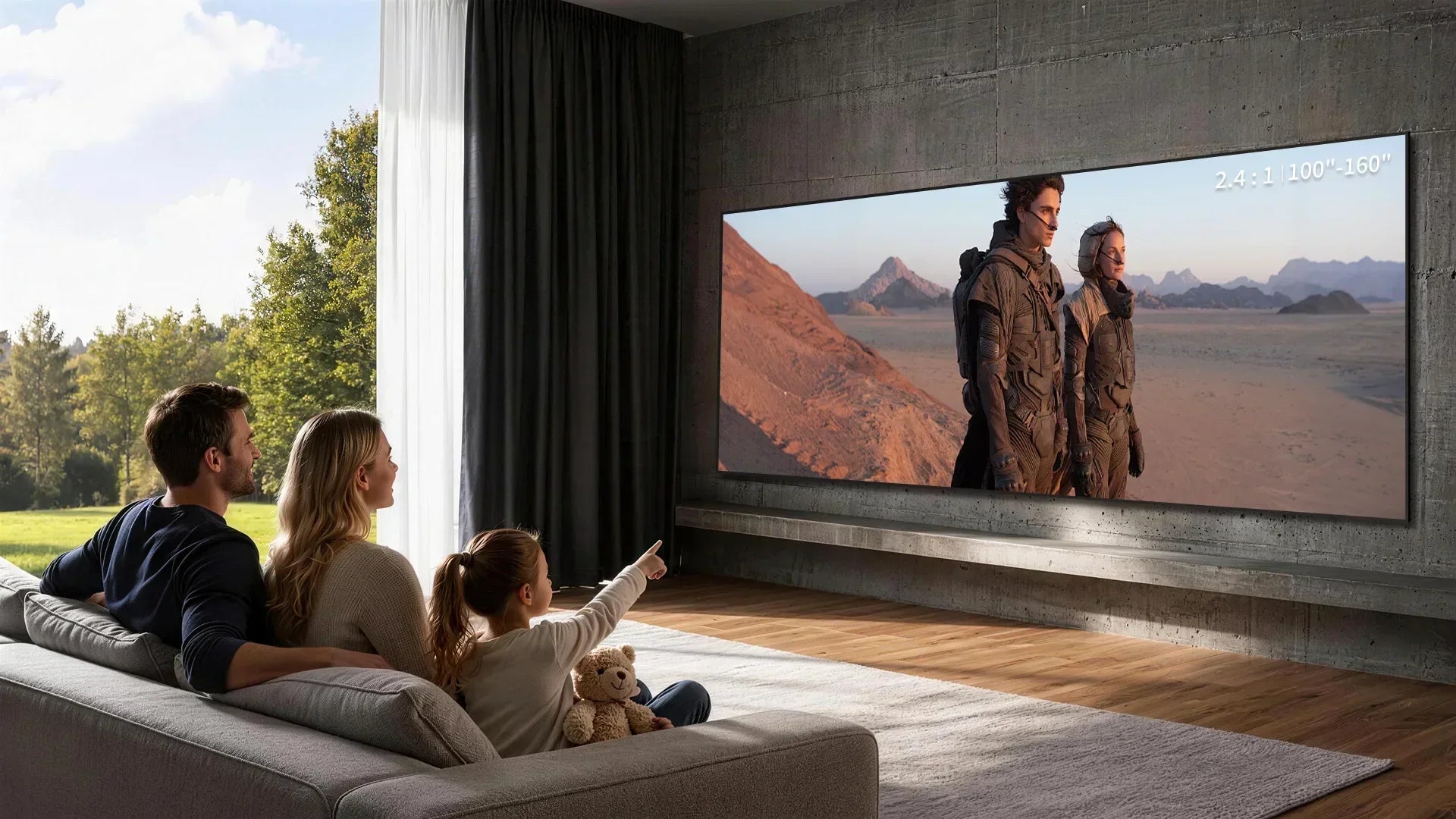

The Hardware Catalyst: From Destructive Digital Zoom to Pure Optical
Historically, adopting a native 2.4:1 Cinemascope screen at home was considered a luxury reserved for high-end, custom-built theater installations.
The challenge was never the screen itself, but the limitations of consumer projection systems.
To fill an ultra-wide format, most projectors relied on digital zoom or image cropping. In practice, this means part of the 4K imaging panel is simply turned off — discarding millions of pixels from the top and bottom of the frame. The result is a visible reduction in resolution and a noticeable drop in brightness, since a portion of the projector’s light output is effectively unused.
The only professional workaround was the use of external anamorphic lens systems. However, these setups were expensive, bulky, and required precise calibration, making them impractical for most home users.
The industry reached a critical paradigm shift with the rapid convergence of Triple Laser (RGB) light engines and high-performance, professional-grade internal optics. This technical evolution completely demolishes the entry barriers for the ultra-wide format.
A prime manifestation of this architectural leap is the groundbreaking Hisense XR10 4K Triple Laser Projector. Engineered with an absolute focus on uncompromised theatrical accuracy, the XR10 pairs a monstrous 6,000 ANSI Lumens of pure RGB laser brightness with a highly sophisticated 17-element all-glass internal optical lens system.
Crucially for the custom integration market, the XR10 features a powerful 2.38x True Optical Zoom paired with robust hardware Lens Shift capabilities (Vertical ±130% / Horizontal ±46%). This turns 2.4:1 projection into a native, lossless ecosystem via two key transformations:
-
Lossless True Optical Scaling: Utilizing the mechanical lens elements of the Hisense XR10, when a user switches to a 2.4:1 Cinemascope film, the projector physically expands the image horizontally and re-indexes the optical track. Every single native pixel of the imaging chip and 100% of the 6,000 ANSI Lumens of light output are fully utilized. The resolution remains flawlessly crisp, and the cinematic experience retains its native, blinding HDR contrast without losing a single watt of illumination to black borders.
-
Intelligent, Frictionless Aspect Ratio Automation: Equipped with onboard Lens Memory, the modern triple laser system intelligently detects incoming signals or aspect ratio profiles. When viewing televised broadcast or gaming content, the lens seamlessly scales to a standard 16:9 frame. When an anamorphic feature film begins, the glass array instantly shifts and zooms into a precise 2.4:1 frame automatically.


Now that the projector-side bottlenecks have been entirely resolved by hardware innovations like the Hisense XR10, the latent consumer demand for the ultimate wide-screen format is undergoing an unprecedented surge. The 2.4:1 projection screen has officially shifted from an eccentric luxury to an essential upgrade for premium private cinemas.
Notably, this trend is rapidly expanding across the industry. XGIMI has also announced that its XGIMI Titan Noir Max will introduce an enhanced Lens Memory system, allowing users to store and instantly switch between up to 5 different aspect ratios without any manual recalibration or image adjustment. This level of flexibility further reinforces the shift toward true cinematic viewing experiences, where content can be enjoyed in its native format with a single click.

2. When 2.4:1 Demands Giant Scale—We’re Talking 150"+ Seamless
Now that the tech allows it, the question shifts: What do users actually want when they decide to go 2.4:1?
They aren’t looking for 100-inch or 120-inch screens anymore. In the premium home theater market, those sizes have already become mainstream commodities. When a purist opts for a 2.4:1 Cinemascope format, they are talking about giant scale—specifically, breaking past the 150-inch threshold.
Because a 2.4:1 screen is narrower vertically, you must scale up the horizontal width to achieve true, bone-rattling cinematic immersion. A 150-inch 2.4:1 screen demands a continuous horizontal footprint spanning roughly 3.5 meters (11.5 feet). At this colossal scale, ordinary manufacturing limitations expose a massive physical failure point: The Splicing Defect.
As we thoroughly explored and explained in our previous technical article, the physical bottleneck of manufacturing ultra-large screens does not lie in the horizontal plane—machinery can technically weave or roll fabric to near-infinite lengths horizontally. The true limitation is the vertical height restriction of the standard production loom.
When a screen's required vertical height surpasses the raw width of a premium fabric roll, traditional factories are forced to weld or splice multiple sheets together horizontally to achieve the needed height for massive displays.
WUPRO Lenticular LT Anti-speckle raw material rolls achieve a continuous, unbroken vertical height of up to 1,619 mm. (We’ve referenced this in another blog post covering our Lenticular LT material specifications)

For a 2.4:1 aspect ratio, this corresponds to a maximum diagonal size of approximately 165 inches, meaning it comfortably supports 160-inch ultra-wide screens without any horizontal or vertical splicing.

3. The Fabric Solution: Why WUPRO Lenticular LT Comes First
Most premium projectors with lens shift and true optical zoom are high-end Triple Laser (RGB) laser systems, built to deliver cinema-grade brightness, color, and 4K detail. But this advanced light source also introduces a common issue: laser speckle.
Speckle appears as a subtle shimmering grain on ordinary screens, especially noticeable on large ultra-wide formats. It reduces image purity and prevents the picture from looking truly “clean.”
The WUPRO Lenticular LT Anti-speckle CLR fabric is designed specifically for this challenge, combining ultra-wide scalability with advanced laser optimization.
It enables seamless large-format production up to 160”+ and 2.4:1 Cinemascope sizes, without welding lines or image distortion — ensuring a clean, continuous cinematic surface.
Key Advantages
-
Anti-Speckle Optimization for Triple Laser Projectors
A dedicated micro-structured optical layer helps break up RGB laser coherence, reducing laser speckle to near-invisible levels.

2. Wide Viewing Angle – Up to 170°
Maintains consistent brightness and color from almost any seating position, making it ideal for large living rooms, theaters, and multi-row seating environments.

3. High Ambient (Ceiling) Light Rejection (≥90%+)
Advanced lenticular CLR structure rejects overhead and ambient light effectively, preserving image visibility and contrast even in non-dark environments.

4. Deep Black Performance & High Contrast
Engineered to maintain strong black levels and stable contrast performance, delivering a more cinematic and immersive image compared to standard matte or ALR screens.

5. Flexible Installation Compatibility
Supports multiple projection setups including front projection, ceiling (inverted) mounting, and side projection, offering greater flexibility for different room layouts and installation environments.

The WUPRO Lenticular LT Anti-speckle CLR material is designed specifically for this stage of projection evolution, supporting seamless ultra-wide formats and optimized performance for RGB laser projection systems.
Full technical specifications and available configurations can be found on product page here.
WUPRO Lenticular LT Knowledge Hub
Related articles include:
- How to Choose an ALR or CLR Screen for Long Throw Triple Laser Projector
- How the 160" 2.4:1 Cinemascope Lenticular Screen Achieves Massive Scale Without Fabric Splicing


How the 160" 2.4:1 Cinemascope Lenticular Screen Achieves Massive Scale Without Fabric Splicing
WUPRO Cinema Fixed Frame Series: Gallery vs. Gallery EVO Projector Screen Frames Compared