


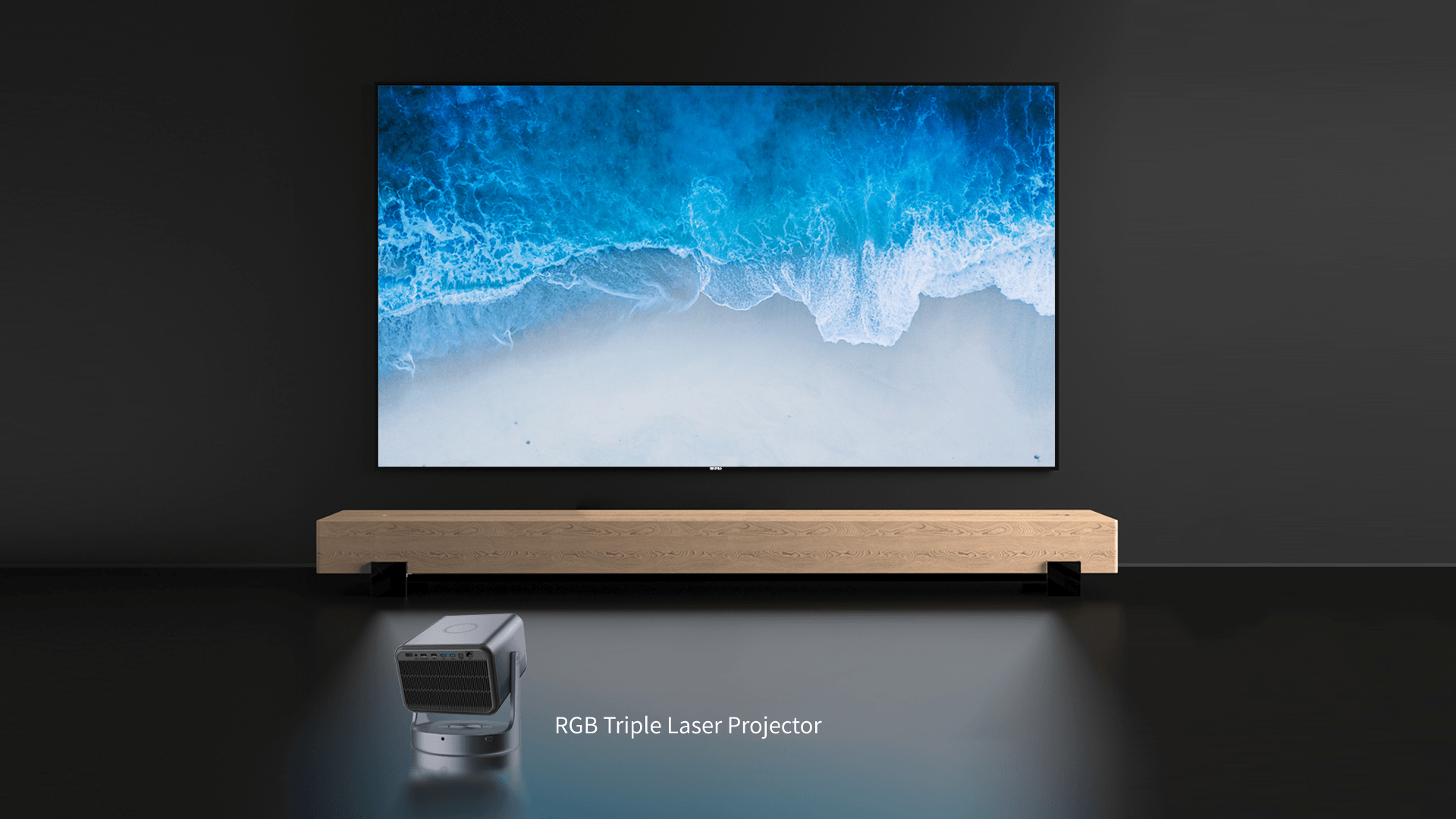
Triple-laser (RGB) long throw projectors have completely redefined premium home theater. With breathtaking Rec.2020 color coverage and massive lumen outputs, these flagships deliver unmatched picture quality. However, pairing them with the wrong projection screen will instantly kill their potential—resulting in washed-out contrast from ambient light or a distracting, grainy "laser speckle" effect.
You need a dedicated Long Throw CLR (Ceiling Light Rejection) screen.

Here is exactly how to choose the right one, how the technology works, and the answers to the most critical technical questions.
1. Why Long Throw Projectors Need a Different ALR Tech
Many people assume all CLR screens are the same. In reality, UST screens and Long Throw screens use different optical structures.
-
UST ALR/CLR Screens (Bottom-Up Light Path): UST screens use a triangular micro-structure designed only to accept light coming from a steep angle directly below the screen. If you shoot a long-throw projector at a UST screen, the screen will misinterpret your projector's light as ceiling light and absorb it, or bounce it straight into the ceiling instead of your eyes.
-
Long Throw ALR/CLR Screens (Angular Reflection): Long-throw setups require an angular reflective ALR fabric. It works on the optical law of reflection: the angle of incidence equals the angle of reflection. It accepts light coming straight from the back of the room and reflects it forward to the viewing cone, while rejecting ambient light from the ceiling and floor.

2. How Does Lenticular LT Reject Ceiling Light?
The absolute gold standard for long-throw ambient light rejection is the Lenticular structure (often designated as Lenticular LT for Long Throw).
The surface of a lenticular screen consists of thousands of microscopic, horizontally aligned optical ridges (cylindrical or linear lenses).
-
The Top Slope: Each ridge is treated with a high-absorption black layer. This layer traps up to 91% of stray ambient light coming from overhead spotlights or windows.
-
The Bottom/Front Slope: The reflecting portion of the ridge is embedded with highly reflective coatings engineered to bounce the horizontal projector beam directly into the theater seats, preserving a bright 1.0 Gain and an ultra-wide 170° viewing angle.

3. The Triple Laser Challenge: Solving "Laser Speckle"
Triple-laser (RGB) projectors utilize three discrete, highly coherent red, green, and blue laser diodes. Because these light waves are perfectly in phase, they interfere with one another when bouncing off traditional high-gain or basic ALR screens. This creates a shimmering, grainy, or "artifact-heavy" texture known as laser speckle.
To counteract this, advanced long-throw lenticular screens incorporate a proprietary Anti-Speckle Micro-Coating. This structural optical layer micro-diffuses the laser beam precisely at the screen's surface. It disrupts the laser's phase coherence just enough to eliminate over 90% of visible speckle while keeping the 4K text, fine details, and pixel boundaries perfectly razor-sharp.


4. Ultimate Technical FAQ: Long Throw CLR/ALR & Lenticular Screens
Below are the definitive technical answers to the industry's most common questions.
Q: Does Lenticular LT Work With RGB Triple-Laser Projectors?
A: Absolutely. Lenticular LT was developed specifically for modern RGB laser projectors, including:
• Valerion VisionMaster Max & Pro
• XGIMI Titan Noir Max
• XGIMI Horizon 20 Max
• Hisense C3 Ultra
• JMGO N3 Ultra Max
• Dangbei MP1 Max
Q: Can I Mount My Projector On The Ceiling?
A: Yes. Unlike UST Fresnel screens, Lenticular LT is fully compatible with ceiling-mounted, rear-shelf, and standard front-projection installations. This makes it ideal for dedicated home theaters, gaming rooms, and living room projector setups.
The reason is its symmetrical lenticular optical structure. The screen rejects ambient light from above and below with the same effectiveness, allowing it to maintain consistent image performance whether the projector is placed on a table or mounted on the ceiling.
If you have seen a material sample, you may notice that the image looks virtually identical when the sample is turned upside down. This demonstrates that the optical structure is not orientation-dependent, enabling the screen to support both ceiling-mounted and tabletop projector installations without compromising image quality.

Q: Can a Lenticular Long Throw screen support ultra-wide seating arrangements?
A: Yes. Unlike traditional retro-reflective beaded screens which have a very narrow sweet spot (often less than 60°), a high-tier horizontal lenticular layout distributes light uniformly across a 170° viewing cone.


Q: What installation parameters should I watch out for with long throw ALR?
A: The project throw ratio is critical. Most angular-reflective lenticular screens require a minimum throw ratio of 1.5:1 (meaning the distance from the lens to the screen should be at least 1.5 times the width of the screen). If a projector is placed too close, the extreme angles at the outer edges of the screen will cause light to be misdirected, leading to vignetting or dim corners.

Q: What If My Projector Doesn't Meet The Recommended 1.5:1 Throw Ratio?
The 1.5:1 throw ratio is a recommended guideline to achieve the most uniform brightness and optimal CLR performance across the entire screen surface.
In theory, placing the projector too close to the screen can increase the projection angle at the top and bottom edges, causing some light to be reflected less efficiently.
However, in real-world viewing conditions, the difference is usually much less noticeable than the theoretical data suggests. This is because brightness naturally varies slightly across the entire image, not just at the edges.
Q: Can I Use Lenticular LT During The Day?
A: Yes. The CLR optical structure rejects a large portion of ambient light coming from above and from the sides, making it suitable for bright living rooms and multi-purpose spaces. For the best image quality, moderate light control is still recommended.
Q: Why Is Lenticular LT Available Only As A Fixed Frame Screen?
A: The lenticular optical structure must remain perfectly flat to maintain image uniformity and ambient light rejection performance. Even minor waves or curling can affect the viewing experience. For this reason, Lenticular LT is currently offered exclusively in a rigid fixed-frame design.
Q: What If I Need A Motorized Screen Instead?
A: Lenticular LT delivers exceptional contrast, ambient light rejection, and laser speckle suppression. However, its optical structure requires a perfectly flat surface, which means it is currently available only as a fixed-frame screen.
If your living room requires a motorized drop-down screen or a floor-rising system, there are still several excellent alternatives depending on your priorities.

Q: Is Lenticular LT Better Than Matte Grey?
A: It depends on your room conditions and viewing priorities.
Lenticular LT is designed for users who need both ambient light rejection and laser speckle reduction. Compared to Matte Grey, it delivers significantly better contrast and daytime performance thanks to its optical CLR structure.
Matte Grey remains the more affordable option and offers excellent laser speckle suppression. It is also available in fixed-frame, motorized drop-down, and floor-rising versions, making it a more flexible choice for many installations.
If your room has ambient light and you want the best overall image quality, choose Lenticular LT. If your room can be darkened and laser speckle reduction is your top priority, Matte Grey remains an excellent value option.
Q: How Does Lenticular LT Compare To Long Throw Fresnel Screens?
A: Both Lenticular LT and Long Throw Fresnel screens are premium ALR solutions designed for high-end long throw projectors. The best choice depends on your priorities.
We recommend watching the video comparison. To make things easier, we have summarized the key observations mentioned by the Nikos from Projector Junkies.
✓ Better Laser Speckle Suppression
The anti-speckle optical structure helps reduce visible laser speckle, especially when paired with modern RGB triple-laser projectors.
✓ Wider Viewing Angle
Lenticular LT maintains image consistency across a wider seating area, making it more suitable for family rooms and multi-seat environments.
✓ Improved Shadow & Dark Scene Detail
The optical structure preserves more subtle details in dark scenes.

Q: How Does Lenticular LT Compare To Standard Projection Screens?
✓ Reduced Laser Speckle
The advanced anti-speckle optical structure helps significantly reduce visible laser speckle, especially when paired with RGB triple-laser projectors. With ultra-high brightness RGB laser projectors, slight speckle may still be visible in certain scenes, but it is greatly minimized.
✓ Vivid Colors in Dark Rooms
In a fully darkened home theater environment, Lenticular LT reveals rich colors, excellent contrast, and fine image details, allowing the projector’s full color performance to shine.
✓ Maintained Contrast Under Ambient Light
When viewing in rooms with ambient lighting, Lenticular LT continues to preserve strong contrast and image depth, helping maintain a clear and immersive viewing experience.
Watch the full review here

Dark Room Performance
With the lights off, Lenticular LT delivers a true cinematic experience with deeper blacks, vibrant colors, and enhanced shadow details.

Ambient Light Performance
With the lights on, the optical structure helps reject unwanted ambient light while maintaining contrast, color accuracy, and overall image clarity.

Q: Why Can I Still See Laser Speckle in Certain Scenes?
A: No projection screen can completely eliminate laser speckle. Speckle is an inherent characteristic of laser projection systems, especially high-brightness RGB triple-laser projectors.
In most cases, speckle is only noticeable in very bright, uniform scenes—such as clear skies, white backgrounds, ice rinks, or large areas of solid color. During normal movie watching, gaming, and mixed-content viewing, it is typically much less visible.
The Lenticular LT material is specifically engineered to strike a balance between speckle suppression and light rejection. While it significantly reduces visible speckle compared to traditional ALR materials, it also preserves the contrast and brightness needed for viewing in rooms with ambient light.
To further reduce speckle, a matte white projection surface can be used. However, this comes at the cost of losing most ambient light rejection capabilities. Lenticular LT is designed to provide the best compromise between these two competing requirements, making it one of the most practical solutions for modern RGB laser projectors.
Q: Does Lenticular LT Support 4K, 8K, HDR And 3D?
A: Yes. The screen material is fully compatible with 4K, 8K, HDR, HLG, Dolby Vision source content, and active 3D projection systems. Image quality will ultimately depend on the capabilities of your projector.
Q: What Is The Maximum Size Available For The Lenticular LT Screen? Can It Be Made Larger Than 130"?
A: The maximum seamless size for the Lenticular LT screen is 130" in a 16:9 aspect ratio.
Due to material manufacturing limitations, we cannot produce a seamless 16:9 screen larger than 130".
If you require a larger screen, we can offer Max 160" versions in a 2.35:1 or 2.40:1 aspect ratio, which are ideal for dedicated home theater installations and cinematic viewing experiences. Please contact us before placing your order.


Q: Is the 160 Inch 2.4:1 Screen Spliced?
A: No. The 160-inch 2.4:1 Cinemascope version remains seamless and made from a single piece of lenticular material.
Its 1563 mm viewing height remains below the 1619 mm material limit, allowing it to be produced from a single piece of lenticular fabric without any stitching.
You can learn more in our article: "How the 160" 2.41:1 Cinemascope Lenticular Screen Achieves Massive Scale Without Fabric Splicing"
Q: Can screens over 130 inches (16:9) be spliced together if i prefer bigger screen in 16:9?
A: No, splicing is not possible for lenticular LT.
This material is one of the most delicate and structurally demanding fabrics we work with. At the same time, it is also relatively thick compared to standard projection materials. Due to these characteristics, current splicing technologies cannot guarantee a perfectly seamless and flat surface after joining.
This is also one of the reasons why this fabric cannot be used in floor-rising screen systems. In floor-rising designs, the black bottom bar area would still require a small structural joint, which can easily lead to visible creasing or tension inconsistency during deployment.
Ready to unlock the true potential of your RGB Laser setup? Explore the technical specifications and live demo certifications on our official WUPRO Gallery Series Long Throw ALR Product Page.
WUPRO Lenticular LT Knowledge Hub
Related articles include:


WUPRO AIRGO Inflatable Screen Official Owner’s Manual & Buying Guide
How the 160" 2.4:1 Cinemascope Lenticular Screen Achieves Massive Scale Without Fabric Splicing