


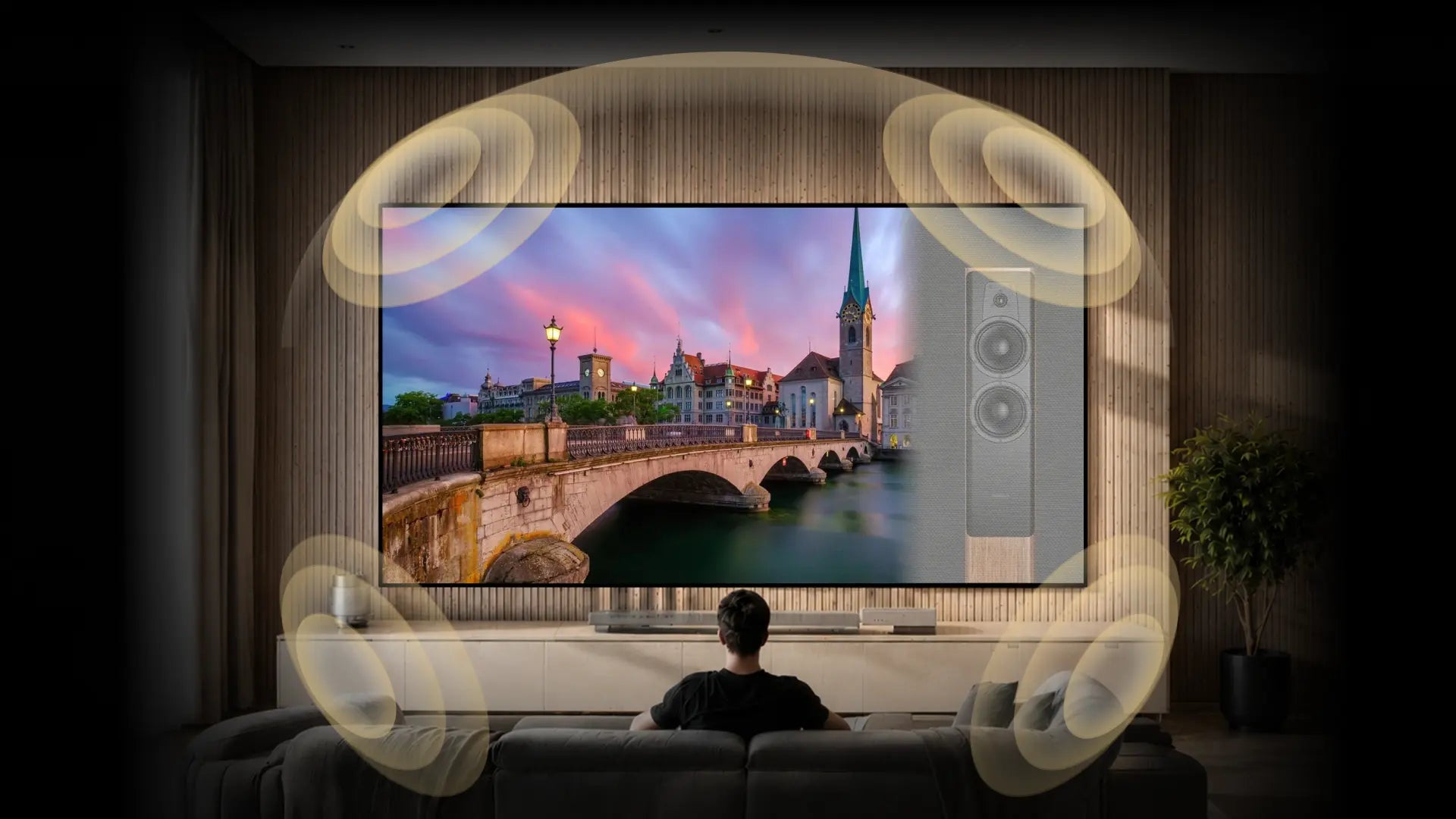
You did the upgrade: an RGB triple-laser projector with brilliant color, deep black levels, and enough brightness to make old bulb projectors feel ancient. Then two things happened.
First, you noticed a faint, shimmering grain across the image that was never there before — laser speckle. Second, you realized the sound still comes from boxes in front of you, not from the image. The cinema magic is missing.
Both problems have the same cinema-proven answer: a 4K woven acoustic transparent (AT) projector screen. Commercial theaters have used this trick for decades — the screen sits in front of the speakers, so dialogue and effects arrive from exactly where the picture is. The right woven material also happens to be one of the most effective ways to reduce laser speckle.
This guide covers everything: how woven AT screens work, why RGB laser owners choose them, how they compare with perforated and matte screens, the real story on moiré, and a step-by-step decision framework so you can judge for your own room — not just take our word for it.
In this guide:
- What is a 4K woven acoustically transparent screen?
- Why RGB triple-laser projector owners choose woven fabric (including the physics of laser speckle)
- Woven AT vs. perforated AT soft matte white
- What "acoustic attenuation" really means
- Moiré: what it is, why it happens, and how premium 4K weaves avoid it
- Black backing: when you need it, when you don't
- Viewing distance, room conditions, and installation tips
- Who should buy one, who shouldn't, and the 3 questions to ask first
- Technical Specifications of the 4K Woven Acoustic Screen
What is a 4K woven acoustically transparent screen?
A woven AT screen is a projection surface made from thousands of precisely woven fibers. The fabric contains millions of microscopic openings that let sound waves pass through with very little energy loss, while still reflecting projected light back to the viewer as a smooth, opaque-looking image.

Why RGB Triple-Laser Projector Owners Prefer Woven Screens
Modern RGB triple-laser projectors offer:
- Higher brightness
- Wider color gamut
- Stronger contrast performance
However, laser projection can create a phenomenon called laser speckle.
Laser speckle happens because laser light has a highly coherent wavelength. When reflected from a projection surface, tiny interference patterns can appear as sparkling grain or noise.
A fine woven screen structure helps by:
- Diffusing reflected laser light
- Breaking up interference patterns
- Reducing visible RGB laser speckle
Therefore, woven screens are often recommended for users with:
- Valerion VisionMaster series
- XGIMI Titan series
- Hisense RGB laser projectors
- Other high-brightness triple-laser projectors

Woven AT vs. perforated AT Soft Matte White
There are two ways to make a screen acoustically transparent — woven fabric, or a solid material with thousands of tiny perforations. They look similar from a distance but behave very differently.
| Feature | 4K Woven AT | Perforated Soft Matte White |
|---|---|---|
| Screen Color (Unprojected) | Warm off-white | Bright white |
| Perceived Brightness | Softer, more natural image | Higher brightness with a more vivid appearance |
| Laser Speckle Reduction | Excellent (up to 97%) | Very good (around 90%) |
| Image Character | Smooth and cinematic | Slightly sharper with stronger contrast |
| Acoustic Structure | Woven fabric | Micro-perforated PVC |
| Best Match | RGB triple-laser projectors | Lamp, LED and laser projectors where maximum brightness is preferred |

Gain & Brightness Note
Although 4K Woven AT has a 1.1 gain and Soft Matte White has a 1.0 gain, the Woven material features a warm off-white surface, while Soft Matte White has a brighter white surface with higher reflectivity.
Because of the different surface colors, 4K Woven AT may appear slightly darker in a fully light-controlled, dark room, despite its higher gain. Soft Matte White generally delivers a brighter, crisper image with a more vivid appearance.
The Woven AT is therefore optimized for excellent acoustic transparency and superior laser speckle reduction, while Soft Matte White is better suited when maximum brightness and image crispness are the priority.
What "acoustic attenuation" really means
A premium woven acoustic screen should minimize sound loss while maintaining accurate audio reproduction.
Important acoustic measurements include: Acoustic Attenuation
Acoustic attenuation describes how much sound energy is reduced when passing through the screen.
Lower attenuation means:
- Less sound loss
- More natural dialogue
- Better speaker performance
High-quality woven screens are engineered to minimize acoustic attenuation across the audible frequency range.

Moiré on Woven Screens: What It Is, Why It Happens, and How to Avoid It
Moiré is the question every woven-screen buyer asks — let's answer it properly.
What is moiré?
Moiré is an optical interference pattern that appears when two or more repeating patterns overlap. In a projection setup, several repeating structures are in play:
- The projector's pixel grid
- The screen's weave pattern
- Camera or viewing-angle patterns
When these patterns interact, you can see wavy lines or shimmering bands across the image.

Why does moiré happen on woven screens?
A woven screen has a regular fiber structure. Moiré becomes visible when:
- The weave pattern is too coarse for the projector's resolution
- The projector's pixel grid "locks" with the weave spacing
- The viewing distance is very close
- The projector is not aligned perpendicular to the screen
How premium 4K woven fabrics minimize it
Manufacturers control moiré at the material level:
- Finer fiber structure
- Higher weave density
- Optimized thread spacing that does not resonate with 4K pixel pitch
A fine texture may still be visible at extremely close distances — this is a normal characteristic of woven material, not a defect. At normal viewing distances (around 3 meters / 10 feet or more for typical home theater sizes), the weave disappears and the image reads as smooth 4K.
If you do see moiré, try these fixes
- Rotate the screen material 180° to change the weave orientation
- Adjust the projector zoom slightly to change pixel alignment
- Fine-tune the projector distance for the best image matching
- Make sure the projector is positioned perpendicular to the screen surface

Do You Need a Black Backing Layer?
A black backing layer is not always required — but it can meaningfully improve contrast depending on your room.
Because AT fabric lets sound through, it also lets some light through. Without a black backing:
- Light can pass through the fabric
- The wall or objects behind the screen reflect light back
- Perceived contrast drops, especially in the center of the image
Adding a black backing layer:
- Improves perceived contrast
- Reduces rear reflections
- Creates a cleaner, more finished cinema appearance
When a black backing is highly recommended:
- Living rooms with white or light walls behind the screen
- Setups with any ambient light that could bounce from behind
- Rooms where the screen is not mounted against a matte dark surface
When you can skip it:
- Dedicated theaters with a matte black or dark gray wall directly behind the screen
- Setups where maximum acoustic transparency matters more than the small contrast gain
Does WUPRO's 4K Woven Acoustic Screen include a black backing?
By default, no. Our 4K Woven Acoustic Screen is supplied without a black backing layer to maximize acoustic transparency and preserve the most natural sound performance.
A black backing layer is available as an optional upgrade for customers who would like enhanced perceived contrast or are installing the screen in rooms with light-colored walls or reflective surfaces behind the screen.
Viewing Distance and Texture Visibility
Because woven fabric contains microscopic structure, viewing from very close range can reveal a slight texture. This is a physical property of woven material — not a defect.
In practice:
- Below roughly 2 meters (6.5 ft): fine weave texture may be visible on bright scenes
- Around 3 meters / 10 feet and beyond (typical seating for 100–150" screens): the weave is visually invisible; the image reads as smooth, detailed 4K
- 4K-optimized fine weaves push the visible-texture threshold much closer than older coarse weaves
Rule of thumb: if your seating distance is normal for your screen size, a premium 4K woven AT screen will not show texture.
Ideal Room and Installation Conditions
For the best results with a woven AT screen:
- Light control: dedicated theater or living room with controlled ambient light. Woven AT is a neutral, light-transmitting material — it is not designed to fight sunlight.
- Room surfaces: neutral or dark side walls and ceiling minimize secondary reflections and maximize contrast
- Speakers: place front speakers a few inches behind the fabric, aimed at ear height
- Projector: any quality 4K projector works; RGB triple-laser models benefit most from speckle reduction
- Wall behind the screen: matte black or dark gray is ideal; otherwise add a black backing layer
Who Should Choose a 4K Woven AT Screen? The 3-Question Test
Instead of a long spec list, ask yourself these three questions:
1. Do you see laser speckle with your projector? If you own an RGB triple-laser projector (Valerion VisionMaster, XGIMI Titan, Hisense C-series, and similar) and notice grain on bright scenes, woven material is the single most effective screen-side fix.
2. Do you want your speakers hidden behind the screen? If you care about cinema-style sound placement — dialogue anchored to the image, no visible front speakers — an AT screen is required, and woven is the better AT material for laser projectors.
3. Is your room light-controlled? If yes, woven AT is an excellent choice. If your room has large windows and you need ambient light rejection, look at CLR/ALR material instead.
Technical Specifications of the 4K Woven Acoustic Screen
Below are the key specifications and performance highlights of the 4K Woven Acoustic Screen, designed for modern home cinemas and advanced projection systems.

Ready to Upgrade Your Home Theater?
A 4K woven AT screen is the single upgrade that improves picture and sound at the same time — reducing laser speckle, preserving 4K detail, and unlocking cinema-style behind-screen audio.
WUPRO Cinema offers 4K woven AT screens in two formats:
- Fixed frame — the reference choice for dedicated home theaters
- FlowArc electric drop-down — the same woven AT performance in a motorized format for multi-purpose rooms
If you're unsure which format or size fits your room, tell us your projector model and room dimensions — that's exactly the information we need to recommend the right setup. Your image and your sound should come from the same place.


Why AWOL Vision Aetherion Deserves the WUPRO Cinema LeApex CBSP Smart Motorized Floor Rising Screen
Woven AT Motorized Drop-Down Projector Screen: Motorized Cinema for Multi-Purpose Rooms