


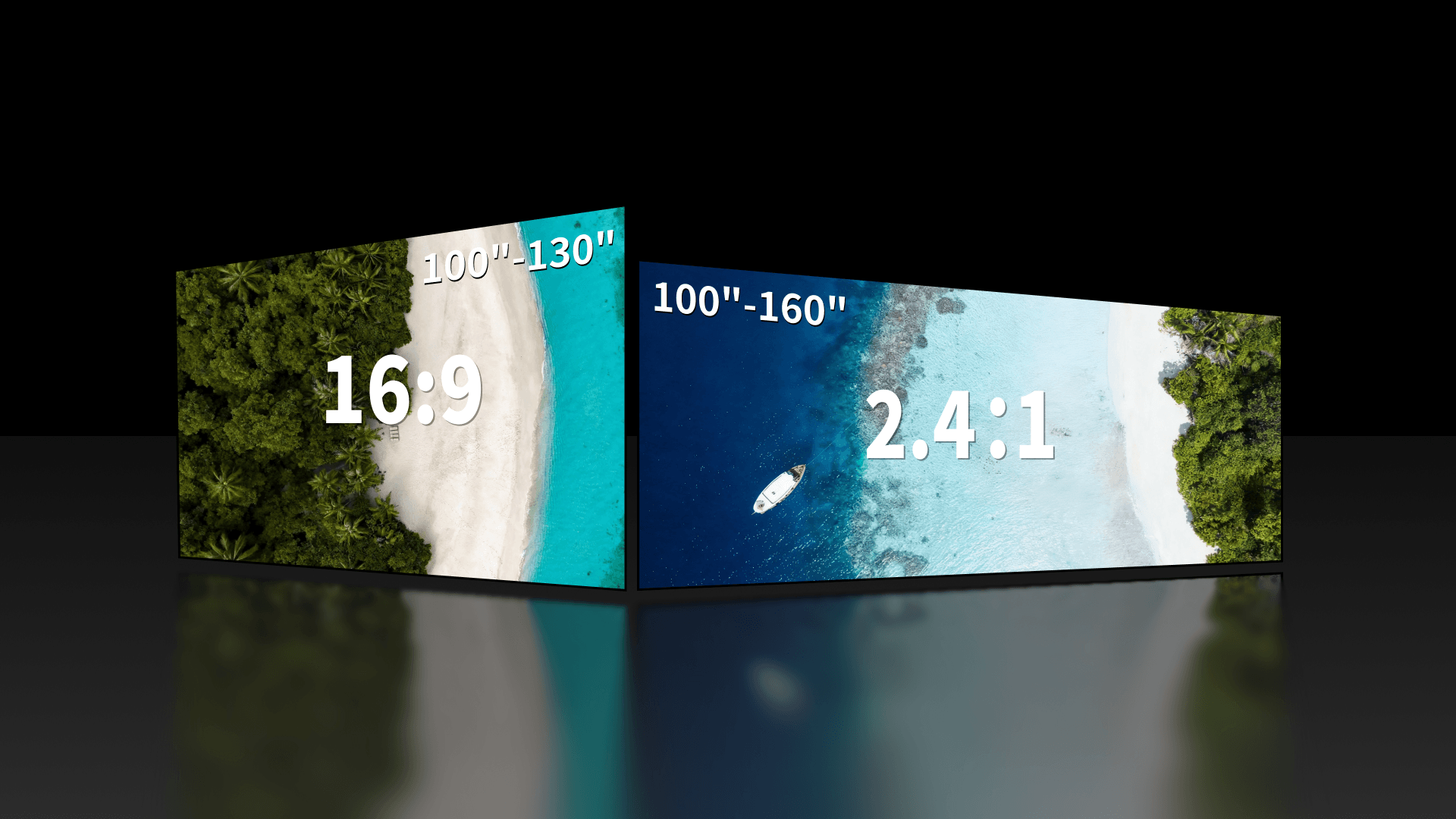
Dans la communauté du cinéma maison, une nouvelle spécification pour notre écran Gallery Series Anti-Speckle Long Throw (Lenticulaire LT) a suscité un grand intérêt : le format 2.4:1 Cinemascope, disponible jusqu'à une taille impressionnante de 160 pouces.
Pour les passionnés expérimentés familiers avec notre gamme, cela pourrait soulever une question : Étant donné que nos écrans traditionnels au format 16:9 atteignent un maximum de 130 pouces, comment est-il possible d'avoir maintenant une version de 160 pouces ? Est-ce le résultat d'une percée dans la couture ou le raccordement physique du tissu ?
Chez WUPRO Cinema, nous croyons en la transparence technique. La réponse n'implique pas de couture complexe ou d'épissure structurelle. En fait, ce matériau lenticulaire de qualité supérieure reste sans couture. L'explication réside entièrement dans la relation entre la hauteur du rouleau physique du matériau optique et les mathématiques géométriques.
1. La Contrainte Principale : La Limite de Hauteur de Rouleau de 1619 mm
Lors de la conception d'écrans optiques composites de haute précision, la matière première est fabriquée en grands rouleaux continus. Pour maintenir l'alignement exact des microstructures lenticulaires et garantir une image 4K impeccable, le matériau ne doit jamais être épissé horizontalement ou verticalement.
Pour la série Gallery Lenticular LT, la limite physique absolue de la largeur de ce rouleau principal — appelée dans l'industrie la hauteur maximale du rouleau — est exactement de 1619 mm.
Par conséquent, la hauteur de vision de toute configuration d'écran finie (à l'exclusion du cadre extérieur) ne peut excéder 1619 mm si elle doit rester une surface optique monobloc sans couture.

2. Les Mathématiques Derrière la Limite du Format d'Image 16:9
Pour comprendre pourquoi le format d'image 16:9 culmine à 130 pouces, nous pouvons examiner les dimensions physiques requises par la géométrie standard des écrans larges :
-
130 pouces (Format 16:9) :
-
Largeur de visualisation : ~2878 mm
-
Hauteur de visualisation : 1619 mm
-
-
150 pouces (Format 16:9) :
-
Largeur de visualisation : ~3320 mm
-
Hauteur de visualisation : 1868 mm ❌ (Dépasse la limite de rouleau maître de 1619 mm)
-
Comme le démontrent les calculs, agrandir un écran 16:9 à 150 pouces nécessite une hauteur de visualisation de 1868 mm. Parce que cela dépasse notre limite de production de 1619 mm, sa création nécessiterait de coudre deux morceaux de tissu ensemble — un processus qui introduit une couture horizontale visible et dégrade l'uniformité de la projection laser 4K. Pour préserver une qualité d'image de référence, WUPRO Cinema ne propose pas d'options assemblées.
3. La Solution Géométrique : L'Avantage du Cinemascope 2.4:1
En passant au format 2.4:1 plus large et davantage orienté cinémascope, utilisé par les studios de cinéma hollywoodiens, la dynamique physique change considérablement. Examinons les dimensions du modèle grand écran de 160 pouces :
-
160 pouces (Format 2.41:1) :
-
Largeur de visualisation : ~3751 mm
-
Hauteur de visualisation : 1563 mm ✓ (Bien en deçà de la limite de rouleau maître de 1619 mm)
-
Étant donné qu'un écran 2.41:1 est considérablement plus large par rapport à sa hauteur, une diagonale de 160 pouces crée un champ de vision expansif tout en maintenant la hauteur de visualisation totale à un modeste 1563 mm. Cela rentre dans la hauteur maximale de rouleau de 1619 mm de notre matériau optique premium.


Remarque d'intégration WUPRO : Si vous sélectionnez le modèle 2.41:1 de 160 pouces, assurez-vous que votre projecteur à longue focale dispose d'un système de mémoire d'objectif automatisé ou qu'il est associé à un objectif anamorphique.
Découvrons ensemble votre expérience Cinemascope de 160 pouces. Le choix entre un écran 16:9 de 130 pouces et un écran 2.41:1 de 160 pouces dépend entièrement des dimensions de votre pièce et des capacités de votre projecteur. Ne vous fiez pas à des suppositions — laissez nos spécialistes produits confirmer la compatibilité de votre objectif et la disponibilité en entrepôt.
WUPRO Lenticular LT Centre de Connaissances
Articles connexes :
- Comment choisir un écran ALR ou CLR pour un projecteur triple laser à longue focale
- Bannir les barres noires : pourquoi les vrais cinéphiles passent aux écrans Cinemascope 2.4:1


Comment choisir un écran ALR ou CLR pour un projecteur triple laser à focale longue
Bannir les barres noires : pourquoi les vrais cinéphiles passent aux écrans Cinémascope 2.4:1