


You've read about 4K woven acoustic transparent (AT) screens — how they reduce laser speckle, preserve 4K detail, and let you hide speakers behind the screen for true cinema sound. Then you looked at your living room and hit the real-world problem: a fixed frame screen would permanently claim your wall.
Maybe you want the TV to stay usable. Maybe you don't want a giant black frame dominating the room when guests arrive. Maybe that wall is shared with a work area or a window.
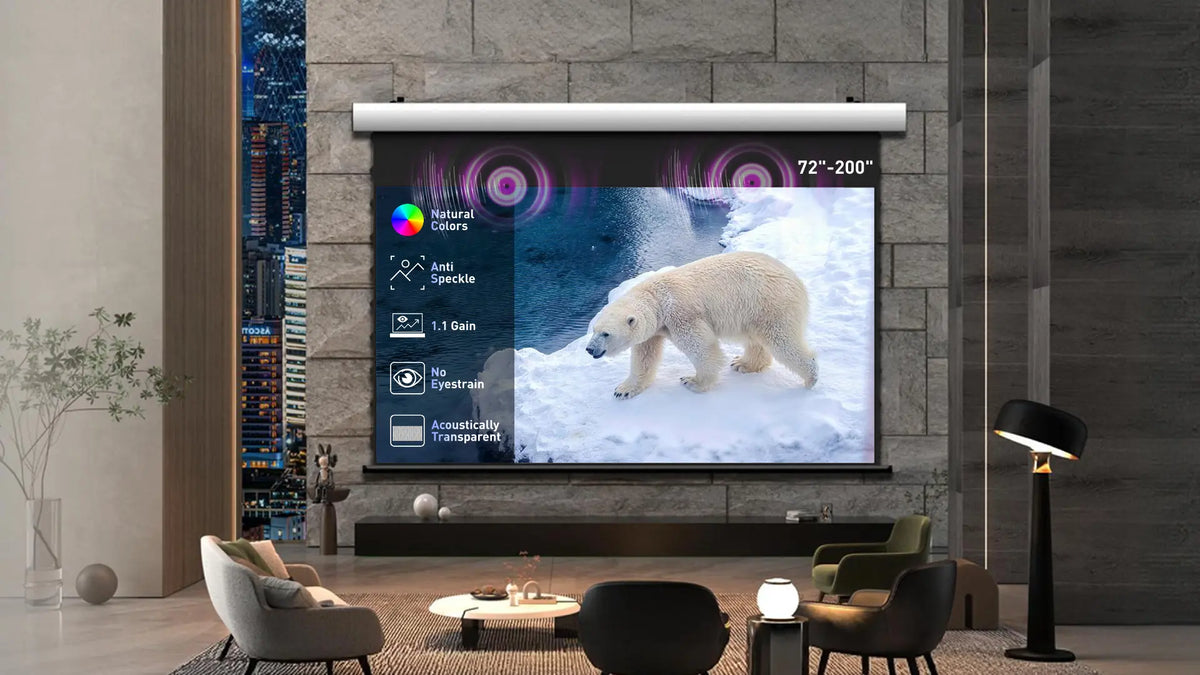
This is exactly what a woven AT electric drop-down screen is for. It delivers the same woven AT image quality — speckle reduction, behind-screen speakers, natural film-like picture — and then rolls away out of sight when the movie ends.
This guide covers how motorized woven AT screens work, the honest differences vs. fixed frames and standard motorized screens, the common worries (wrinkles, curl memory, noise, sagging), and a simple decision framework for your room.
In this guide:
- The screen at a glance: full spec sheet
- Why RGB triple-laser owners choose this screen (the speckle physics, with real answers)
- 10 real buyer questions, answered with real data
- Fixed frame vs. electric drop-down: which WUPRO woven AT format fits you
The Screen at a Glance: Verified Specs
| Spec | WUPRO Cinema FlowArc Woven AT Drop-Down |
|---|---|
| Screen material | Woven Acoustically Transparent (high-density woven, PVC) |
| Gain | 1.1 |
| Viewing angle | 160° |
| Available sizes | 72"–150" (72 / 84 / 92 / 100 / 110 / 120 / 133 / 150 ) |
| Aspect ratio | 16:9 default; custom 21:9, 2.35:1, 2.40:1 CinemaScope available |
| Custom sizes | Yes — seamless custom sizes up to 200" |
| Model | WS31012 |
| Casing | Aluminum alloy, black or white |
| Control | RF remote, voice, app, and projector sync (Google Assistant / Amazon Alexa / Tuya) |
| Installation | Wall mount, ceiling mount, suspended/hidden |
| Throw compatibility | UST, short throw, and long throw; LED, laser, and RGB triple-laser |
| Black backing layer | No (by design — maximizes acoustic transparency; black borders are painted on, removable on request) |
| Black drop | Adjustable via remote |
| Power outlet | Left side by default; right side customizable |
| Warranty | 2-year manufacturer warranty |
Why RGB Triple-Laser Projector Owners Choose This Screen
1. It reduces laser speckle — and WUPRO publishes the practical answer
Laser speckle happens because laser light is coherent: its waves are synchronized, and when they reflect off a surface, microscopic surface variations create interference patterns — the shimmering grain you see on bright scenes. RGB triple-laser projectors are the most affected because their red, green, and blue light is the most coherent light source in home projection.
The woven fabric attacks speckle physically. Its fiber structure scatters reflected laser energy, breaking up the interference patterns before they reach your eye.
The real-world number: WUPRO's own guidance states that in most cases, when viewing distance exceeds 3 meters, speckle becomes almost invisible.
The honest caveat: no screen completely eliminates speckle, and some high-brightness triple-laser models (Hisense C2/C3 Pro & Ultra, Valerion VisionMaster Pro/Max, XGIMI Titan Noir Max, Horizon 20 Pro/Max) show speckle more than others. WUPRO is transparent about this: metallic-coated materials (Grey Crystal, Black Crystal) do not suppress speckle; woven and soft matte materials do.

2. Cinema-grade sound placement
The woven AT structure lets sound from behind-screen speakers pass through naturally. Unlike perforated screens, the random woven structure minimizes high-frequency reflections and comb filtering — the artifacts that make dialogue sound hollow or "closed-in."

3. A room that stays a room
At the press of a button, the screen descends from a slim aluminum casing and retracts completely when you're done. The wall stays yours — TV included.

4. Universal projector compatibility
This is a genuine differentiator for the woven AT category: the FlowArc woven version supports UST, short throw, and long throw projectors — plus LED, laser, and RGB triple-laser systems.

The 10 Questions Real Buyers Ask — Answered with Real Data
1. "Will a woven AT screen make my image darker?"
Every acoustically transparent screen trades some light for sound pass-through. The question is how much — and the answer is in the gain number (1.0 = reference white).
The FlowArc Woven fabric is rated at gain 1.1 — which is notably good for a woven AT material.
The honest comparison: WUPRO's own FAQ notes that in a fully light-controlled room, their Soft Matte White material appears slightly brighter and crisper than Woven, because it has a brighter white surface. The woven fabric's advantage is on the speckle and acoustic side — choose based on your priority, not on hype.

2. "Does it really reduce laser speckle, or is that marketing?"
It's physics. The fiber structure scatters coherent laser light and breaks up interference patterns. WUPRO's official position: speckle is significantly reduced with woven/soft materials, and at viewing distances over ~3 meters it becomes almost invisible in most cases. That's a measurable, practical claim — not an adjective.
3. "Will an electric screen stay flat?"
Flatness comes from the tension system. The FlowArc uses a tab-tensioned design — the fabric is pulled taut from the bottom and sides, which is what keeps a large motorized screen ripple-free. Combined with the clamp-shaft transport design, the fabric arrives and stays flat.
4. "How much sound actually gets through?"
The Woven material is a high-density open weave — it passes sound across the audible range, and the woven (rather than perforated) structure avoids the high-frequency comb filtering that dulls dialogue on perforated screens. The design priority is stated plainly: WUPRO ships this fabric without a black backing layer specifically to maximize acoustic transparency. If you need rear light-blocking, paint the wall behind it matte black or dark gray.
5. "Will it work with my projector?"
Almost certainly yes. The FlowArc Woven version supports:
- UST (ultra-short throw)
- Short throw
- Long throw
- RGB triple-laser, laser, and LED projectors
There are no strict limits on projector placement — ceiling-mounted, front, or table projection all work, as long as the fabric type matches the projector's throw (woven AT is compatible across the board).
6. "Can I watch during the day?"
Woven AT is a neutral, light-transmitting material — it is not an ambient light rejecting screen. It performs best in controlled lighting: a dedicated room, or a living room where you can dim the light. If your space has large windows and you need daytime TV-quality picture without light control, an ALR/CLR screen is the better tool; if you want behind-screen speakers and speckle reduction, this is the trade-off woven AT is designed for.

8. "What size should I choose?"
The screen is available in 72"–150" in 16:9, with custom aspect ratios (21:9, 2.35:1, 2.40:1).
9. "How hard is installation?"
Easier than a fixed frame in most rooms:
- Wall mount — the standard choice; sliding rails allow flexible screw positioning to match your studs
- Ceiling mount — clean look, drops from above
- Suspended/hidden — for bulkheads and hidden installations
The package includes two types of mounting brackets. The casing's adjustable sliding rails are a real convenience: you can position the mounting screws to fit your home layout rather than the other way around. Power is the only planning item — outlet is on the left by default, and right-side placement is customizable on request.
10. "How long will it last, and what's the after-sales situation?"
- Fabric: engineered for daily use — UV resistant, anti-static, mildew resistant, flame retardant, and washable with a mild detergent (soft microfiber cloth)
- Motor: the one wear component; the FlowArc carries a 2-year manufacturer warranty
Fixed Frame vs. Electric Drop-Down: Which Woven AT Format Fits You?
WUPRO makes the same Woven AT material in two formats: the Gallery fixed frame and the FlowArc electric drop-down.
| Factor | Gallery Woven AT (fixed frame) | FlowArc Woven AT (drop-down) |
|---|---|---|
| Image flatness | Reference-grade constant tension | Excellent with tab-tension system |
| Wall space | Permanent | Reclaimed when retracted |
| TV coexistence | Not practical | Yes — drops in front of TV |
| Installation | Wall/stand, one-time | Wall/ceiling/suspended + power point |
| Motor / moving parts | None | Quiet motor + roller |
| Best room | Dedicated theater | Living room, shared walls, TV front |
| Sizes | 70"–230" seamless | 72"–150" |

Is It Right for You?
Choose the FlowArc 4K Woven AT if you: own an RGB triple-laser projector and want speckle reduction · want behind-screen speakers with natural, non-comb-filtered dialogue · have a TV or shared wall that rules out a fixed frame · want UST + long-throw flexibility in one screen.
Choose a fixed frame (Gallery woven AT) if you: have a dedicated theater where the screen never needs to hide · want the absolute reference flatness of permanent tension · prefer zero moving parts.
And if you're between formats or sizes, the sample kit is the honest way to decide: feel the fabric, check the texture at your seating distance, then commit.


4K Woven Acoustic Transparent (AT) Projector Screen Guide: Why RGB Triple-Laser Projector Owners Are Making the Switch