


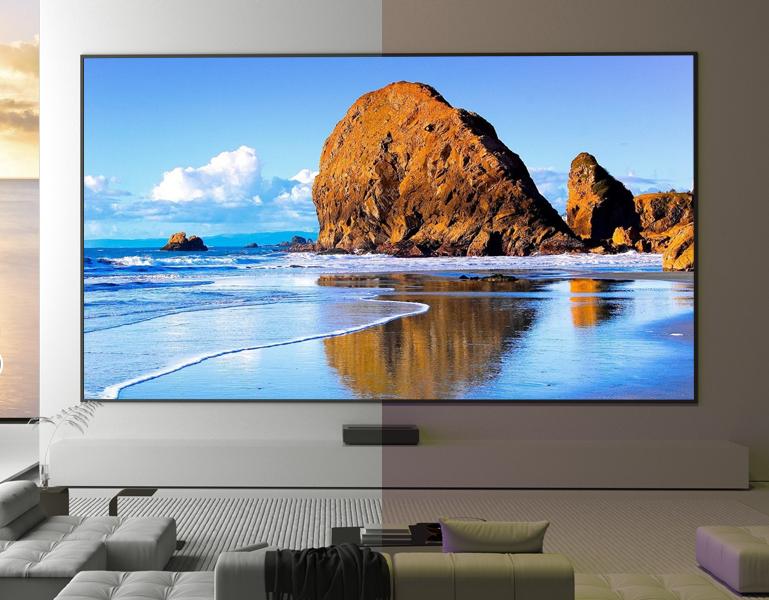
Quick answer: First match the screen to your projector’s throw type. Fresnel UST and lenticular UST are designed for the steep light path of an ultra-short-throw projector placed below the screen. Fresnel LT and lenticular LT are designed for long-throw projection. Within the UST category, Fresnel often favors a bright, centered daytime image; lenticular UST often favors wider seating and control of light from above. The best choice still depends on the specific fabric, room and projector.
Many screen comparisons stop at “Fresnel versus lenticular.” That skips the most consequential distinction: both optical families can be engineered for either ultra-short-throw (UST) or long-throw (LT) projection. An LT projector is not automatically compatible with a UST screen just because both carry an ALR label. This guide explains the light paths, the practical tradeoffs, and how WUPRO Cinema names its fabrics and screen series.
The four screen categories at a glance
| Optical family | Projector path | WUPRO fabric name | Where it fits | Key caution |
|---|---|---|---|---|
| Fresnel | UST, projected upward from below | Fresnel UST | Peacock / Peacock EVO fixed-frame screens; motorized floor-rising and drop-down versions are upcoming | Centered seating and the intended projector position matter |
| Fresnel | Long throw | Fresnel LT | Upcoming WUPRO Cinema screen options; confirm format and launch details before ordering | Do not substitute Fresnel UST for an LT setup |
| Lenticular | UST, projected upward from below | CBSP, KBSP, or Lenticular UST: three distinct WUPRO fabrics | Gallery / Gallery EVO fixed frame; LeApex / LeApex EVO floor rising; FlowArc drop down and Cirrus in-ceiling, depending on fabric, size and listing | Compare the exact fabric and product, rather than treating all three as identical |
| Lenticular | Long throw | Lenticular LT | Gallery-series fixed-frame anti-speckle screen | Check throw ratio and optical alignment; do not use as a UST substitute |
Availability is product and size dependent. “Upcoming” is a development direction, not an orderable option or a promised launch date.
Start with the projector, not the fabric
A UST projector sits close to the wall, commonly on a low cabinet, and sends light steeply upward. Examples include the Hisense PX3-PRO and PT1, Formovie Theater Premium, AWOL Vision Aetherion Max, Epson LS800 and Samsung LSP9T. These are examples of projector placement, not a claim that every listed screen has been tested with every model. Check the actual installation position: a ceiling-mounted UST sends light from above and can defeat a UST fabric designed to accept light from below.
A long-throw projector sits farther back and sends light toward the screen at a shallower angle. Examples include the XGIMI Horizon 20 Pro and Titan Noir Max, Valerion VisionMaster Max, Epson Home Cinema 3800 / EH-TW7100 and Dangbei Mars Pro 2. Throw ratio, lens height and mounting position vary by model. For a directional LT ALR screen, confirm the fabric’s required throw ratio and orientation before purchase; WUPRO generally recommends a throw ratio of at least 1.5:1 for its Lenticular LT.
ALR means ambient light rejecting: a broad category of screens that reduce the effect of some unwanted room light. CLR means ceiling light rejecting: it describes rejection of light arriving from above, often relevant to UST setups. Neither acronym alone tells you whether the surface is for UST or LT, how wide its bright seating zone is, or whether it reduces laser speckle.
How a Fresnel screen works
A Fresnel screen uses a layered, directional optical surface with concentric or curved microstructures. The structure is designed to receive projected light from a particular range of directions, return more of it toward viewers, and reduce the effect of light from other directions. Fresnel UST is engineered around the upward beam from a tabletop UST projector. Fresnel LT must use optics designed for a long-throw beam; the Fresnel name does not make the two interchangeable.
For a typical UST living room, Fresnel’s appeal is high perceived brightness and contrast from the main viewing position under difficult daylight, including some side light. Its directional behavior also creates a tradeoff: a viewer far to one side can see a dimmer image than someone seated near the center. Strong light shining toward the screen from roughly the viewer’s direction remains difficult for any ALR material to reject. Blinds and sensible lamp placement still matter.
At WUPRO Cinema, the currently listed Peacock EVO Fresnel fixed-frame screen is a Fresnel UST option; Peacock is another UST fixed-frame listing. Fresnel motorized floor-rising and drop-down screens, as well as Fresnel LT options, are upcoming. Verify the product’s projector-throw designation in its own listing when those options launch.
How a lenticular screen works
A lenticular ALR/CLR surface uses repeated directional ridges, often with a reflective face and a darker light-absorbing face. In a UST lenticular design, the reflective geometry accepts light coming up from a projector below the screen while reducing the effect of light from above. Its horizontal distribution can serve a wide sofa more evenly than a more center-focused Fresnel UST screen. How well it handles side light depends on the particular material and room.
A lenticular LT surface must instead be engineered for the shallower light path of a projector farther back. The word “lenticular” describes an optical family; it does not identify one universal projector angle or one fixed level of gain, light rejection or speckle suppression.
WUPRO’s Gallery Lenticular LT anti-speckle fixed-frame screen is the long-throw counterpart. It is worth considering for some RGB-laser LT setups, such as an XGIMI Titan Noir Max or Valerion VisionMaster Max, when overhead-light control is useful. Speckle varies with projector, screen, image content and viewer sensitivity; request a sample and assess it in your own room.
CBSP, KBSP and Lenticular UST: what do the names mean?
These are three WUPRO Cinema UST lenticular fabric names, not three names for the exact same surface. They share the requirement for a compatible UST light path, but can differ in contrast, gain, screen size, construction and available formats. A product series (Gallery, LeApex, FlowArc or Cirrus) describes the screen structure and installation; the fabric name describes the optical surface. Confirm both when comparing listings.
| UST lenticular fabric | Current examples on WUPRO Cinema | What to verify |
|---|---|---|
| CBSP | Gallery CBSP, Gallery EVO CBSP, LeApex CBSP, FlowArc CBSP; selected Cirrus options | Size, gain, angle definition and room-light direction. CBSP prioritizes contrast and wide UST seating; visible speckle may be reduced on some setups, not eliminated. |
| KBSP | 133-inch seamless Gallery-series KBSP | Its specific 133-inch size and construction; do not assume its optical measurements equal CBSP’s. |
| Lenticular UST | 150-inch seamless Gallery-series Lenticular UST, 150-inch floor-rising Lenticular UST, FlowArc Lenticular UST; selected Cirrus options | Actual product size, format and optical specification; generic “lenticular UST” does not establish that it is CBSP or KBSP. |
For a permanent installation, start with a Gallery-family listing. For a screen that rises from a cabinet, check LeApex or the dedicated large-format floor-rising listing. For a ceiling drop-down format, check FlowArc or Cirrus and verify that the selected variant explicitly uses a UST fabric. A motorized case name by itself does not establish UST compatibility.
Fresnel UST vs lenticular UST: practical tradeoffs
| Decision factor | Fresnel UST | Lenticular UST |
|---|---|---|
| Brightest central seat in a difficult daytime room | Often a strong choice because of directional gain; exact result is model dependent | Can still perform well, but check the specific fabric’s gain and lighting conditions |
| Wide sofa and off-axis seats | Brightness may fall more noticeably away from the center | Often distributes brightness more evenly across a wider horizontal seating area |
| Overhead lights | Designed to reject off-axis light, with model-specific performance | UST CLR structure is especially aimed at light from above |
| Strong side light | Some Fresnel UST designs can be advantageous; test with the real window positions | Depends strongly on angle and fabric; ceiling-light rejection is not a blanket side-light claim |
| RGB laser speckle | Can remain visible; assess the exact screen-projector pairing | CBSP and some other surfaces can reduce perceived speckle, but no universal guarantee |
| Retractable installation | WUPRO motorized Fresnel formats are upcoming | Current WUPRO floor-rising, drop-down and in-ceiling listings exist for selected fabrics |
These are selection principles, not side-by-side laboratory results. Published ALR percentages, gain and viewing angles may use different measurement methods. In particular, a stated total horizontal viewing cone is not the same thing as a half-gain angle, where brightness has fallen to 50% of its on-axis value. Request comparable measurements under the same test method before ranking two materials numerically.
How to choose in five steps
- Identify throw type and mounting. Is the projector directly below the image (UST), or farther back (LT)? Is the projector on a cabinet or ceiling mounted? An upside-down UST installation changes the beam direction and may make a UST CLR screen unsuitable.
- Map the room light. Note windows, ceiling fixtures and lamps, and whether light actually falls on the screen. Daylight coming from several directions, overhead light and light near the viewing axis are different problems.
- Map the seats. A centered single sofa and a wide sectional have different needs. If side seats matter, ask for brightness at the actual viewing angles, not just a headline “viewing angle.”
- Choose the installation. Gallery and Peacock are fixed frame; LeApex rises from below; FlowArc descends from above; Cirrus is concealed in the ceiling. Then choose a fabric listed for that product and your throw type.
- Check a sample for RGB laser speckle. If your Hisense PT1, AWOL Aetherion Max, XGIMI Titan Noir Max, Valerion VisionMaster Max or other laser projector produces visible grain or sparkle, compare candidate fabrics with real content at your normal seat. Laser type alone cannot predict how sensitive you will be to the result. A WUPRO screen fabric sample kit can help narrow the options.
Example A: A tabletop Hisense PX3-PRO with windows on both sides and mostly centered seating: compare Peacock EVO Fresnel UST with a Gallery CBSP option, prioritizing real daytime performance from the main seat.
Example B: A tabletop Formovie Theater Premium or AWOL Aetherion Max with a wide family sofa and mainly overhead light: start with a Gallery CBSP or other appropriately sized UST lenticular option, then check speckle and brightness with a sample.
Example C: A ceiling-mounted XGIMI Horizon 20 Pro or Valerion VisionMaster Max: compare Lenticular LT with other LT-appropriate materials. Do not pick CBSP, KBSP or Peacock Fresnel UST simply because their descriptions mention ALR.
Example D: An Epson LS800 on a cabinet with no permanent screen desired: inspect a compatible LeApex floor-rising UST listing, check the screen size and the projector’s placement geometry, and verify cabinet clearance.
What a useful real-world comparison should measure
Before making a numerical “best screen” claim, use the same projector, image size, calibrated picture mode and content for each screen. Record projector model and light source; throw ratio or UST distance; lens height; screen model and gain; screen size; room illuminance at the screen with lights on and off; positions of windows and ceiling lights; camera exposure if photos are shown; viewer positions and angles; and the test method for gain, ALR and viewing angle. Measure center and side-seat brightness, black level and perceived speckle. Publish the observations and limits along with the numbers.
Test status: This article is an optical and product-selection guide. It does not present controlled head-to-head measurements. WUPRO Cinema will add test conditions, raw measurements and sample images when the comparison has been completed and verified.
Frequently asked questions
Is a Fresnel screen always for UST projectors?
No. Fresnel is an optical design family. Fresnel UST and Fresnel LT are built for different incoming light paths. Buy the version specified for your projector and mounting geometry.
Is a lenticular screen always for UST projectors?
No. WUPRO Cinema has lenticular UST fabrics (CBSP, KBSP and Lenticular UST) and a separate Lenticular LT material for long-throw projection. They are not interchangeable just because their surface structures are related.
Are CBSP, KBSP and Lenticular UST the same fabric?
No. These are distinct WUPRO UST lenticular fabric names. Compare the particular product’s construction, format, size and measured optical specifications rather than transferring one fabric’s numbers to another.
Can I use a UST CLR screen with a regular long-throw projector?
It is generally the wrong match: the light arrives from a different direction and may be absorbed or reflected away from the audience. Choose an LT-specific material and follow its throw-ratio guidance.
Can a ceiling-mounted UST projector use Fresnel UST or CBSP?
Do not assume so. Many UST ALR/CLR surfaces are directional and designed for a projector below the screen. Ask WUPRO to verify the exact orientation and projector model before ordering.
Which is better for a bright room: Fresnel UST or lenticular UST?
For hard daytime light and central seating, Fresnel UST is often worth comparing first. For wide seating and mostly overhead light, lenticular UST may be more comfortable across the sofa. Window and seat positions can change the answer.
Which reduces triple-laser speckle better?
There is no dependable winner by optical-family name alone. CBSP and WUPRO’s Lenticular LT are options to assess, but speckle depends on projector, material, content and the viewer. Compare samples with your own RGB laser projector. A matte or woven screen may be preferable if speckle sensitivity is your top priority and the room is suitably controlled.
Does a 160-degree viewing angle mean 160-degree half gain?
No. A published viewing cone may use a visibility or other criterion. The half-gain angle is a specific brightness measurement. Ask for the test standard and comparable brightness-versus-angle data before comparing two quoted angle values.
What if I need a retractable Fresnel screen?
WUPRO Cinema is preparing motorized Fresnel floor-rising and drop-down options. Check the current catalog for availability; no launch date is asserted here. Selected lenticular UST motorized screens are listed now.
Still deciding?
Send WUPRO Cinema your projector model, mounting position, desired diagonal, throw distance (for LT), daytime photo showing the windows, and a photo or sketch of the seating area. Those details are more useful than an ALR percentage alone. Explore the Peacock EVO Fresnel UST, Gallery EVO CBSP UST and Gallery Lenticular LT pages for the currently listed configurations.
By WUPRO Cinema Product Team · First published September 17, 2026 · Product names and availability reviewed September 17, 2026. Projector brands and models are examples of setup categories; naming does not indicate endorsement or a model-specific performance test.


Tela de projeção elétrica retrátil Woven AT: cinema motorizado para salas multifuncionais
Fresnel Motorized Projection Screens Are Coming to WUPRO Cinema: More Options for Long-Throw and UST Projection