


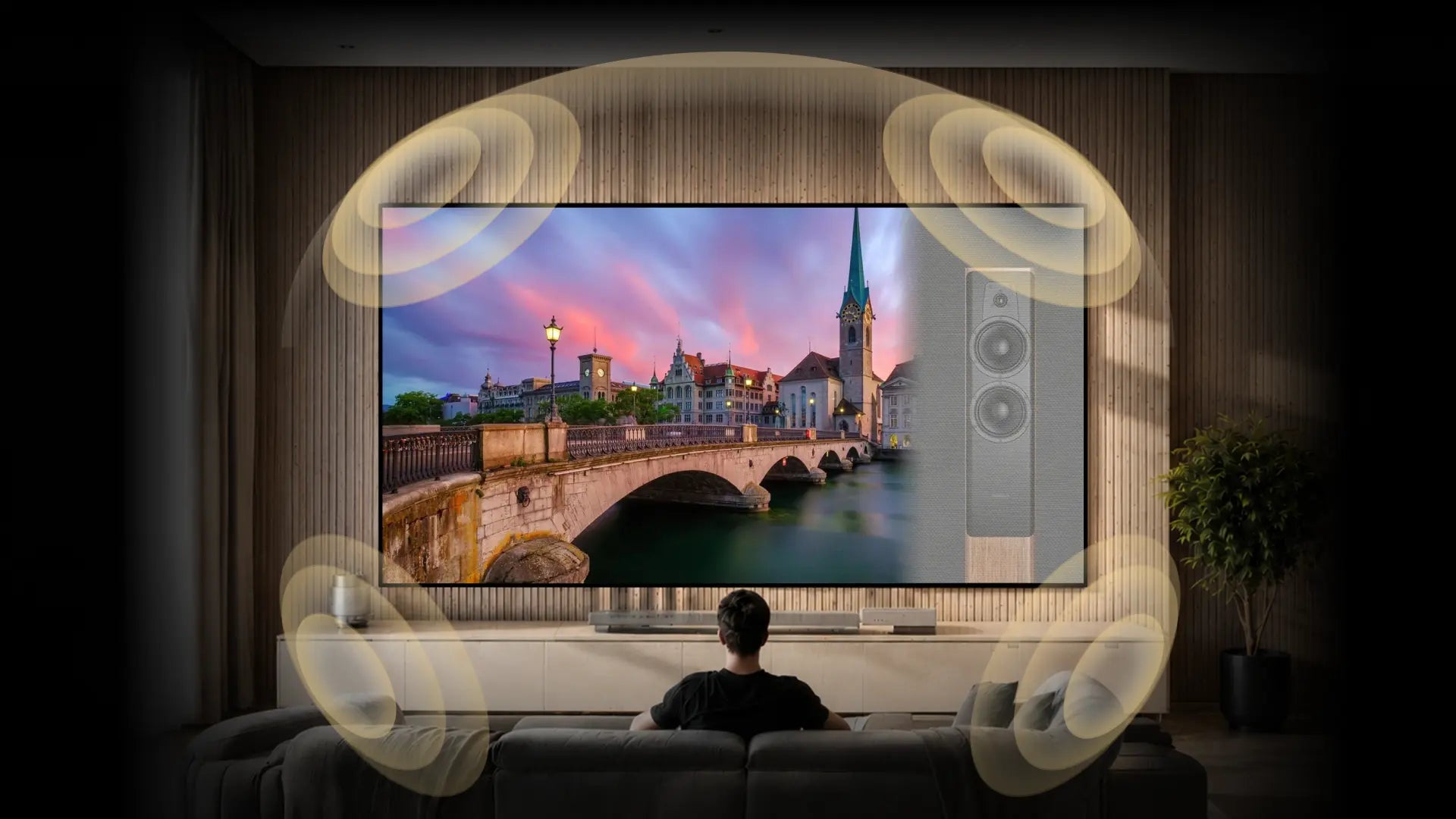
Sie haben das Upgrade durchgeführt: einen RGB-Triple-Laser-Projektor mit brillanten Farben, tiefen Schwarzwerten und ausreichender Helligkeit, um alte Lampenprojektoren veraltet aussehen zu lassen. Dann passierten zwei Dinge.
Zuerst bemerkten Sie ein schwaches, schimmerndes Korn im Bild, das vorher nie da war – Laser-Speckle. Zweitens stellten Sie fest, dass der Ton immer noch aus den Lautsprechern vor Ihnen kam, nicht aus dem Bild. Die Kino-Magie fehlte.
Beide Probleme haben dieselbe kinoprobfte Lösung: eine akustisch transparente (AT) 4K-Gewebe-Leinwand. Kommerzielle Kinos verwenden diesen Trick seit Jahrzehnten – die Leinwand befindet sich vor den Lautsprechern, sodass Dialoge und Effekte genau dort ankommen, wo das Bild ist. Das richtige Gewebematerial ist auch eine der effektivsten Methoden, um Laser-Speckle zu reduzieren.
Dieser Leitfaden deckt alles ab: wie gewebte AT-Leinwände funktionieren, warum RGB-Laser-Besitzer sie wählen, wie sie sich von perforierten und matten Leinwänden unterscheiden, die wahre Geschichte über Moiré und einen schrittweisen Entscheidungsrahmen, damit Sie selbst für Ihren Raum urteilen können – und sich nicht nur auf unser Wort verlassen müssen.
In diesem Leitfaden:
- Was ist eine 4K-Gewebe-Akustikleinwand?
- Warum Besitzer von RGB-Triple-Laser-Projektoren gewebte Stoffe wählen (einschließlich der Physik des Laser-Speckles)
- Gewebe AT vs. perforierte AT weichmatte weiße Leinwand
- Was "akustische Dämpfung" wirklich bedeutet
- Moiré: was es ist, warum es auftritt und wie Premium-4K-Gewebe es vermeiden
- Schwarze Rückseite: Wann Sie sie brauchen, wann nicht
- Betrachtungsabstand, Raumbedingungen und Installationstipps
- Wer sollte eine kaufen, wer nicht, und die 3 Fragen, die man zuerst stellen sollte
- Technische Daten der 4K-Gewebe-Akustikleinwand
Was ist eine 4K-Gewebe-Akustikleinwand?
Eine gewebte AT-Leinwand ist eine Projektionsfläche, die aus Tausenden präzise gewebter Fasern besteht. Der Stoff enthält Millionen von mikroskopisch kleinen Öffnungen, die Schallwellen mit sehr geringem Energieverlust durchlassen, während sie gleichzeitig das projizierte Licht als glattes, undurchsichtig aussehendes Bild zum Betrachter zurückwerfen.

Warum Besitzer von RGB-Triple-Laser-Projektoren gewebte Leinwände bevorzugen
Moderne RGB-Triple-Laser-Projektoren bieten:
- Höhere Helligkeit
- Breiteren Farbraum
- Stärkere Kontrastleistung
Allerdings kann die Laserprojektion ein Phänomen namens Laser-Speckle erzeugen.
Laser-Speckle entsteht, weil Laserlicht eine hochkohärente Wellenlänge hat. Wenn es von einer Projektionsfläche reflektiert wird, können winzige Interferenzmuster als funkelndes Korn oder Rauschen erscheinen.
Eine feine gewebte Leinwandstruktur hilft durch:
- Streuung des reflektierten Laserlichts
- Aufbrechen von Interferenzmustern
- Reduzierung des sichtbaren RGB-Laser-Speckles
Daher werden gewebte Leinwände oft für Benutzer empfohlen, die Folgendes besitzen:
- Valerion VisionMaster Serie
- XGIMI Titan Serie
- Hisense RGB Laser-Projektoren
- Andere Triple-Laser-Projektoren mit hoher Helligkeit

Gewebe AT vs. perforierte AT Soft Matte White
Es gibt zwei Möglichkeiten, eine Leinwand akustisch transparent zu machen – gewebter Stoff oder ein festes Material mit Tausenden winziger Perforationen. Aus der Ferne sehen sie ähnlich aus, verhalten sich aber sehr unterschiedlich.
| Merkmal | 4K Gewebe AT | Perforierte weichmatte weiße |
|---|---|---|
| Leinwandfarbe (unprojiziert) | Warmes Off-White | Helles Weiß |
| Wahrgenommene Helligkeit | Weicheres, natürlicheres Bild | Höhere Helligkeit mit lebendigerem Aussehen |
| Reduzierung von Laser-Speckle | Ausgezeichnet (bis zu 97 %) | Sehr gut (ca. 90 %) |
| Bildcharakter | Glatt und filmisch | Leicht schärfer mit stärkerem Kontrast |
| Akustische Struktur | Gewebter Stoff | Mikroperforiertes PVC |
| Beste Übereinstimmung | RGB-Triple-Laser-Projektoren | Lampen-, LED- und Laserprojektoren, bei denen maximale Helligkeit bevorzugt wird |

Anmerkung zu Gain & Helligkeit
Obwohl 4K Woven AT einen Gain von 1,1 und Soft Matte White einen Gain von 1,0 hat, weist das gewebte Material eine warme Off-White-Oberfläche auf, während Soft Matte White eine hellere weiße Oberfläche mit höherer Reflektivität besitzt.
Aufgrund der unterschiedlichen Oberflächenfarben kann 4K Woven AT in einem vollständig lichtkontrollierten, dunklen Raum etwas dunkler erscheinen, trotz des höheren Gains. Soft Matte White liefert im Allgemeinen ein helleres, schärferes Bild mit einem lebhafteren Aussehen.
Die Woven AT ist daher optimiert für ausgezeichnete akustische Transparenz und überlegene Reduzierung von Laser-Speckle, während Soft Matte White besser geeignet ist, wenn maximale Helligkeit und Bildschärfe Priorität haben.
Was "akustische Dämpfung" wirklich bedeutet
Eine hochwertige gewebte Akustikleinwand sollte den Schallverlust minimieren und gleichzeitig eine präzise Audiowiedergabe gewährleisten.
Wichtige akustische Messungen umfassen: Akustische Dämpfung
Die akustische Dämpfung beschreibt, wie stark die Schallenergie beim Durchgang durch die Leinwand reduziert wird.
Eine geringere Dämpfung bedeutet:
- Weniger Schallverlust
- Natürlichere Dialoge
- Bessere Lautsprecherleistung
Hochwertige gewebte Leinwände sind so konstruiert, dass sie die akustische Dämpfung über den gesamten hörbaren Frequenzbereich minimieren.

Moiré auf gewebten Leinwänden: Was es ist, warum es auftritt und wie man es vermeidet
Moiré ist die Frage, die jeder Käufer einer gewebten Leinwand stellt – beantworten wir sie richtig.
Was ist Moiré?
Moiré ist ein optisches Interferenzmuster, das entsteht, wenn zwei oder mehr sich wiederholende Muster überlappen. Bei einer Projektionsanlage sind mehrere sich wiederholende Strukturen im Spiel:
- Das Pixelraster des Projektors
- Das Webmuster der Leinwand
- Muster durch Kamera oder Betrachtungswinkel
Wenn diese Muster interagieren, können Sie wellige Linien oder schimmernde Bänder im Bild sehen.

Warum tritt Moiré auf gewebten Leinwänden auf?
Eine gewebte Leinwand hat eine regelmäßige Faserstruktur. Moiré wird sichtbar, wenn:
- Das Webmuster zu grob für die Auflösung des Projektors ist
- Das Pixelraster des Projektors mit dem Webabstand „einrastet“
- Der Betrachtungsabstand sehr gering ist
- Der Projektor nicht senkrecht zur Leinwand ausgerichtet ist
Wie hochwertige 4K-Webstoffe es minimieren
Hersteller steuern Moiré auf Materialebene:
- Feinere Faserstruktur
- Höhere Webdichte
- Optimierter Fadenabstand , der nicht mit der 4K-Pixelsteigung resoniert
Eine feine Textur kann bei extrem geringen Abständen immer noch sichtbar sein – dies ist eine normale Eigenschaft von gewebtem Material, kein Defekt. Bei normalen Betrachtungsabständen (etwa 3 Meter / 10 Fuß oder mehr für typische Heimkino-Größen) verschwindet das Gewebe und das Bild erscheint als glattes, detailliertes 4K.
Wenn Sie Moiré sehen, versuchen Sie diese Korrekturen
- Drehen Sie das Leinwandmaterial um 180°, um die Webrichtung zu ändern
- Passen Sie den Projektorzoom leicht an, um die Pixelausrichtung zu ändern
- Feineinstellung des Projektionsabstands für die beste Bildanpassung
- Stellen Sie sicher, dass der Projektor senkrecht zur Leinwandoberfläche positioniert ist

Benötigen Sie eine schwarze Rückseitenbeschichtung?
Eine schwarze Rückseitenbeschichtung ist nicht immer erforderlich – sie kann aber den Kontrast je nach Raum deutlich verbessern.
Da akustisch transparente (AT) Stoffe Schall durchlassen, lassen sie auch etwas Licht durch. Ohne schwarze Rückseitenbeschichtung:
- Licht kann durch den Stoff dringen
- Die Wand oder Gegenstände hinter der Leinwand reflektieren Licht zurück
- Der wahrgenommene Kontrast sinkt, besonders in der Bildmitte
Das Hinzufügen einer schwarzen Rückseitenbeschichtung:
- Verbessert den wahrgenommenen Kontrast
- Reduziert Rückreflexionen
- Schafft ein saubereres, vollendeteres Kino-Erscheinungsbild
Wann eine schwarze Rückseitenbeschichtung dringend empfohlen wird:
- Wohnzimmer mit weißen oder hellen Wänden hinter der Leinwand
- Einrichtungen mit Umgebungslicht, das von hinten reflektiert werden könnte
- Räume, in denen die Leinwand nicht an einer matten dunklen Oberfläche montiert ist
Wann Sie darauf verzichten können:
- Dedizierte Heimkinos mit einer mattschwarzen oder dunkelgrauen Wand direkt hinter der Leinwand
- Einrichtungen, bei denen maximale akustische Transparenz wichtiger ist als der geringe Kontrastgewinn
Ist die 4K-Gewebe-Akustikleinwand von WUPRO mit einer schwarzen Rückseitenbeschichtung ausgestattet?
Standardmäßig nicht. Unsere 4K-Gewebe-Akustikleinwand wird ohne schwarze Rückseitenbeschichtung geliefert, um die akustische Transparenz zu maximieren und die natürlichste Klangwiedergabe zu gewährleisten.
Eine schwarze Rückseitenbeschichtung ist als optionales Upgrade erhältlich für Kunden, die einen verbesserten wahrgenommenen Kontrast wünschen oder die Leinwand in Räumen mit hellen Wänden oder reflektierenden Oberflächen hinter der Leinwand installieren.
Betrachtungsabstand und Textursichtbarkeit
Da gewebter Stoff eine mikroskopische Struktur aufweist, kann bei sehr geringem Betrachtungsabstand eine leichte Textur sichtbar werden. Dies ist eine physikalische Eigenschaft von gewebtem Material – kein Defekt.
In der Praxis:
- Unterhalb von etwa 2 Metern (6,5 Fuß): Feine Webstruktur kann auf hellen Szenen sichtbar sein
- Ab etwa 3 Metern / 10 Fuß und darüber hinaus (typischer Sitzabstand für 100–150" Leinwände): Die Webstruktur ist visuell unsichtbar; das Bild erscheint als glattes, detailliertes 4K
- 4K-optimierte Feinwebstoffe verschieben die Schwelle der sichtbaren Textur viel näher als ältere grobe Webstoffe
Faustregel: Wenn Ihr Sitzabstand für Ihre Leinwandgröße normal ist, zeigt eine hochwertige 4K-Gewebe-AT-Leinwand keine Textur.
Ideale Raum- und Installationsbedingungen
Für die besten Ergebnisse mit einer gewebten AT-Leinwand:
- Lichtkontrolle: Dediziertes Kino oder Wohnzimmer mit kontrolliertem Umgebungslicht. Gewebtes AT ist ein neutrales, lichtdurchlässiges Material – es ist nicht dafür konzipiert, Sonnenlicht zu bekämpfen.
- Raumoberflächen: Neutrale oder dunkle Seitenwände und Decke minimieren Sekundärreflexionen und maximieren den Kontrast
- Lautsprecher: Platzieren Sie die Frontlautsprecher einige Zentimeter hinter dem Stoff, auf Ohrhöhe ausgerichtet
- Projektor: Jeder hochwertige 4K-Projektor funktioniert; RGB-Triple-Laser-Modelle profitieren am meisten von der Speckle-Reduzierung
- Wand hinter der Leinwand: Mattschwarz oder Dunkelgrau ist ideal; ansonsten eine schwarze Rückschicht hinzufügen
Wer sollte sich für eine 4K Gewebe-AT-Leinwand entscheiden? Der 3-Fragen-Test
Anstelle einer langen Spezifikationsliste stellen Sie sich diese drei Fragen:
1. Sehen Sie Laser-Speckle mit Ihrem Projektor? Wenn Sie einen RGB-Triple-Laser-Projektor (Valerion VisionMaster, XGIMI Titan, Hisense C-Serie und ähnliche) besitzen und bei hellen Szenen ein Körnchen bemerken, ist gewebtes Material die effektivste Lösung auf Leinwandseite.
2. Möchten Sie Ihre Lautsprecher hinter der Leinwand verstecken? Wenn Ihnen eine kinoreife Klangplatzierung wichtig ist – Dialoge, die am Bild verankert sind, keine sichtbaren Frontlautsprecher – ist eine AT-Leinwand erforderlich, und gewebtes Material ist das bessere AT-Material für Laserprojektoren.
3. Ist Ihr Raum lichtkontrolliert? Wenn ja, ist gewebtes AT eine ausgezeichnete Wahl. Wenn Ihr Raum große Fenster hat und Sie Umgebungslichtunterdrückung benötigen, schauen Sie sich stattdessen CLR/ALR-Material an.
Technische Spezifikationen der 4K Gewebe-Akustikleinwand
Nachfolgend finden Sie die wichtigsten Spezifikationen und Leistungsmerkmale der 4K Gewebe-Akustikleinwand, die für moderne Heimkinos und fortschrittliche Projektionssysteme entwickelt wurde.

Bereit, Ihr Heimkino aufzurüsten?
Eine 4K Gewebe-AT-Leinwand ist das einzige Upgrade, das Bild und Ton gleichzeitig verbessert – sie reduziert Laser-Speckle, bewahrt 4K-Details und ermöglicht kinoähnlichen Klang hinter der Leinwand.
WUPRO Cinema bietet 4K Gewebe-AT-Leinwände in zwei Formaten an:
- Festrahmen — die Referenzwahl für dedizierte Heimkinos
- FlowArc motorisierte Fallleinwand — die gleiche Gewebe-AT-Leistung in einem motorisierten Format für Mehrzweckräume
Wenn Sie unsicher sind, welches Format oder welche Größe zu Ihrem Raum passt, nennen Sie uns Ihr Projektormodell und die Raumabmessungen – genau diese Informationen benötigen wir, um die richtige Einrichtung zu empfehlen. Ihr Bild und Ihr Ton sollten vom selben Ort kommen.


Warum AWOL Vision Aetherion die WUPRO Cinema LeApex CBSP Smart Motorized Floor Rising Screen verdient
Elektrisch ausfahrbare Woven AT Beamer-Leinwand: Motorisiertes Kino für Mehrzweckräume